
Madison County Court Calendars Explained
What does a Madison County court calendar actually tell you? It shows when a court plans to call a type of matter. It can also show a listed event. It is not a full register of every filing. The General Sessions docket schedule covers recurring civil, criminal, protection-order, and traffic settings. Circuit Court posts separate civil and criminal schedules. Chancery keeps its own searchable event calendar. Jackson City Court handles municipal matters through dated docket files.
Where should the search begin? With the court named on your summons, citation, bond paper, pleading, or prior order. Circuit and Criminal Court and General Sessions run as distinct divisions. Gail Mooney serves as clerk for both. Chancery has a separate Clerk and Master. Juvenile cases go to the Juvenile Court Clerk. Jackson municipal settings stay with City Court unless a transfer happens. One more limit: Tennessee Public Case History covers appellate matters only.
Madison County Sessions Calendar
The local General Sessions page posts recurring times. Those times tell you which docket your matter belongs on. Civil matters sit on Monday at 9:30 a.m. Orders of protection run Wednesday at 1 p.m. Criminal arraignments generally start at 8:30 a.m. every day except Wednesday. Criminal summons first appearances are set Tuesday at 8:30 a.m. Criminal trials are listed Tuesday and Thursday at 1 p.m.
Traffic court is Wednesday at 8:30 a.m. Check-in starts at 8 a.m. Treat these times as docket instructions, not a promise about your case. A holiday can move any setting. So can a closure, a judge's order, or a continuance. Check the schedule first, then confirm your individual matter with the proper General Sessions division. The official Madison County docket-times page posts these settings for each division.

The view makes one thing clear. Match a recurring schedule to your case type before you trust a time.
Finding Your Court Date
Use the narrowest reliable source, then confirm the result. Madison County publishes no single case-level calendar across all its courts. A case number, citation number, division, setting notice, and rough date make the clerk's check far sharper than a name alone.
- Read the court and division on the latest notice, summons, citation, or order.
- Check General Sessions dockets, a Circuit schedule, the Chancery calendar, or a Jackson City docket.
- For Circuit records, use the clerk's public computers or records room when a schedule does not identify the case.
- Call or visit the correct clerk's counter with the case number, division, and expected date.
- Use Tennessee Public Case History only for a state appellate matter.
A county records request can fetch a specific county-held record, but it will not confirm a live hearing. For the right channel, the Madison County case lookup routes each kind of case to its proper court.
Madison County Calendar Tools
The Madison County calendar offers start and end dates, phrase search, a past-events choice, a calendar selector, and List, Week, and Month views. General Sessions Court appears among its categories. The listings do not carry case numbers. That makes the tool good for locating a public event category, and poor for building a complete case history. Case-specific answers still come from the clerk.
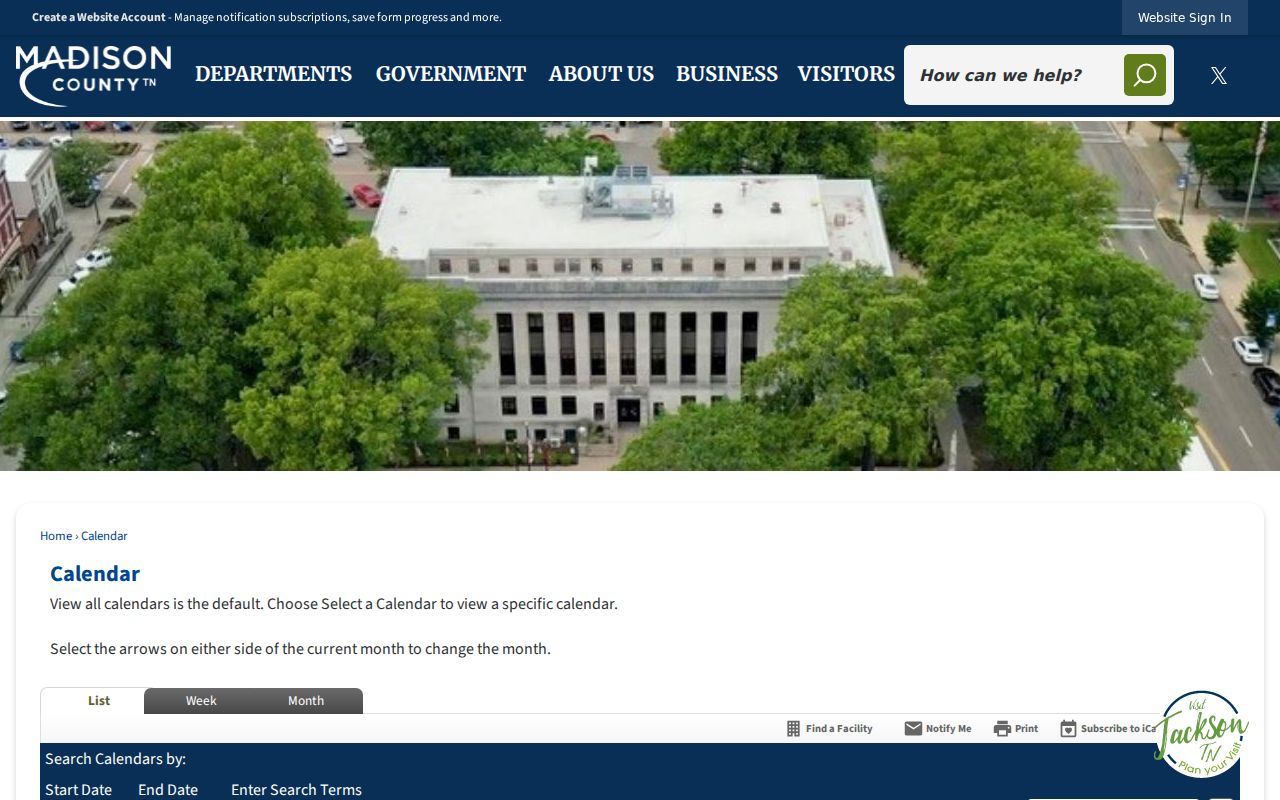
The date and category controls suit broad checks, while case-specific verification stays with the clerk.
| Source | Best use | Key limit |
|---|---|---|
| County calendar | Find a county event category | Not a case register |
| Sessions dockets | Check recurring court times | Not an individual guarantee |
| Circuit schedules | Find division docket calls | May omit case details |
| Jackson library | Review city docket PDFs | Not the full clerk file |
How to Read a Court Setting
A setting is a planned court event. Nothing more. It does not prove a hearing occurred or reveal its result. Read each field together. Then compare it with the latest docket entry or a clerk notice. Circuit civil schedules may show only division, event type, date, and time. A city docket can go further, adding a case number, judge, charge, or status note.
| Date | The day assigned to the court event. |
|---|---|
| Time | The call or hearing time, not the order of one case. |
| Courtroom | The room or location, which should be confirmed if absent. |
| Judge | The presiding judge or division on the current schedule. |
| Setting Type | Arraignment, appearance, motion, docket call, hearing, or trial. |
A docket call may just set deadlines or a later trial date. It rarely decides the whole case that day.
Madison County Chancery Calendar
The Chancery Main Court Calendar supports date ranges and phrase search. You can view past events. A calendar selector is there too. List, Week, Month, Print, Notify Me, and iCalendar controls round it out. Event rows may show a date, an All Day marker, a title, and More Details. These tools track events, not every pleading behind a Chancery case.
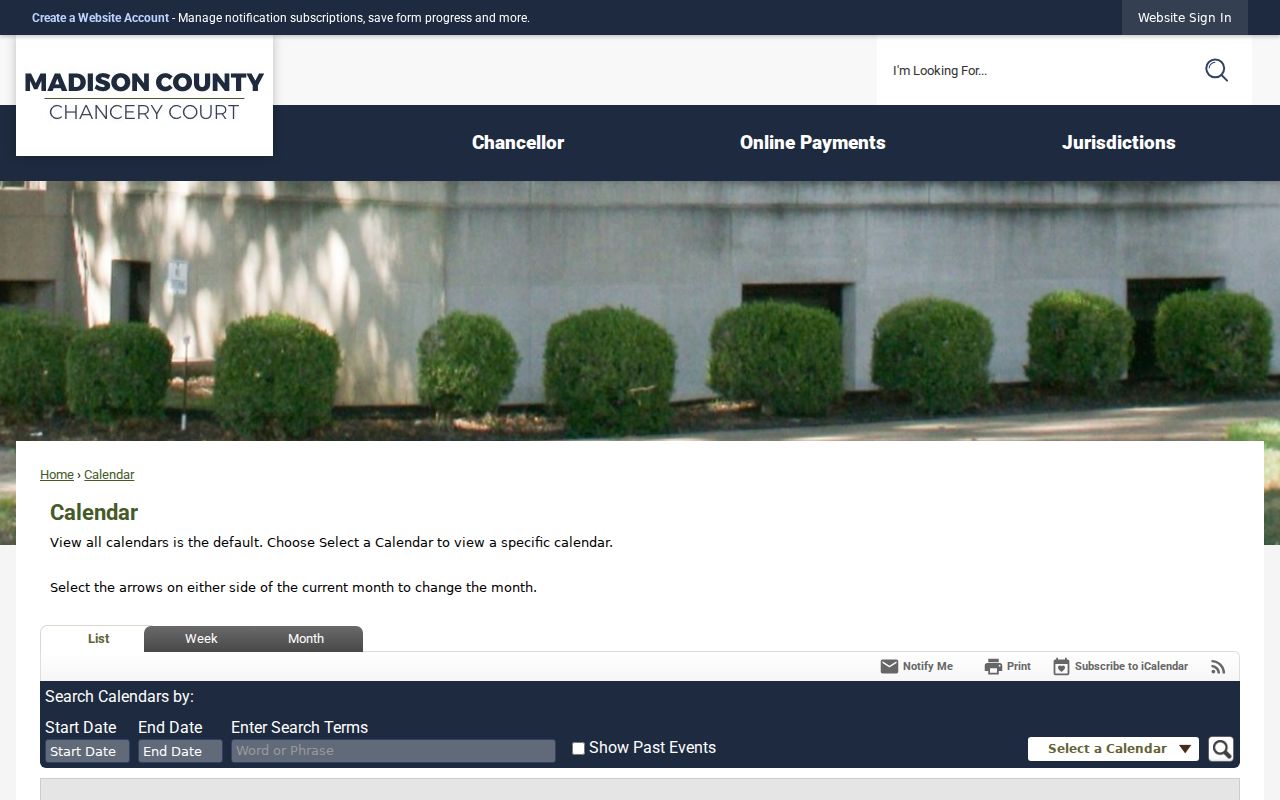
The Chancery FAQ states that internet case information is unavailable. So a blank result does not mean no file exists.
- All Day
- An event label, not a promise one case will be called all day.
- More Details
- Extra event data, not a complete docket or case file.
- Recurring event
- A repeated calendar item that still needs a case check.
- Docket call
- A session to review status, deadlines, readiness, or later action.
Continuances, Resets, and Cancellations
On a Madison County court docket, three words move events around. A continuance shifts a hearing to a later date. A reset gives it a fresh setting. A cancellation takes the event off the calendar for now. None of these terms dismisses the case. Treat them as scheduling changes rather than outcomes. What a case actually did rests on a current clerk entry or a signed order. Not an old PDF. Not a personal note.
When a Madison County court date moves, get the details in writing. Write down who gave the update. Record the confirmation date, the new time and division, and the next step. Ask the clerk whether the old event still shows online. Ask whether a written notice or order issued. If a lawyer is on the case, confirm the change there too. A hearing that drops off the calendar does not end the case by itself.
Note: A reset only changes the setting. A court entry or order establishes the case's true procedural result.
Verify Madison County Court Dates
Call first, then drive. In Madison County, Circuit/Criminal and General Session settings normally sit at the Criminal Justice Complex, 515 S Liberty Street. Chancery matters are heard at the Madison County Courthouse, 100 E Main Street. Juvenile cases go to the Juvenile Court Complex at 110 Irby Street. A current notice or a quick call to the clerk settles it. Ask which room your hearing is in.
One county tool trips people up. The Agenda Center stores meeting materials for county government, so it is not a court docket and will not show your court date. For case lookup, rely on the clerk.
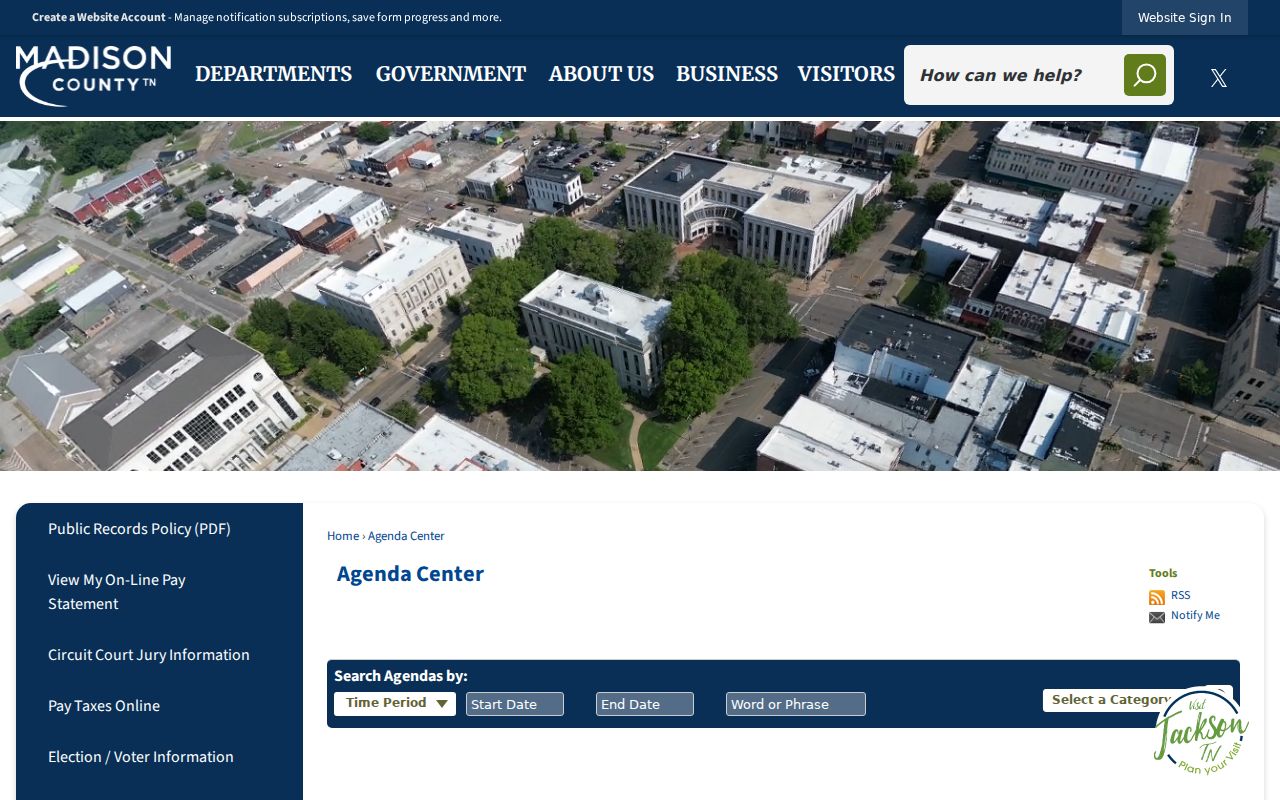
This distinction keeps a county meeting search from being mistaken for a hearing lookup.
Madison County Setting Context
Published schedules reveal how the Madison County courts organize their work. The 2026 Circuit civil material splits Division I and Division II into separate docket calls and motion settings. Criminal entries carry labels like grand jury, arraignment, and appearance. Each label marks a stage or session. It is not a final outcome. Statewide figures add useful workload context. They cannot substitute for the local calendar when you need one specific court date.
For the official numbers, the Tennessee courts publish an annual reports index. It covers statewide court reporting.
Reports describe the system's scale. For one Madison County court date, the clerk and the newest local schedule still govern.
If You Miss a Court Setting
Act fast. Call the clerk for the court and division named on your case. Then call your attorney if you have one. Ask what the docket shows. Ask whether a judge entered a new setting, and whether a warrant, bond action, default, dismissal, or other order issued. Never just show up without knowing where the matter stands.
What a missed setting means depends on the case type. Criminal and traffic dockets can produce a failure-to-appear entry, a warrant, or a bond action. A civil matter might be reset, dismissed, or decided. The outcome follows rules tied to the event and the court's order. Only the current Madison County record tells you what actually happened.
Missed a setting? Call the correct Madison County clerk or City Court now and give the case or citation number.
Ask for the current status, any new date, and the next required step.
Consult a licensed attorney promptly when a warrant, bond issue, default, or other legal consequence may be involved.